
Tidal Power Reading Answers with Explanations
Students who face issues getting good band scores in their IELTS exam must practice with the right type of study material. Therefore, we have provided you the tidal power reading answers along with an explanation. In this write-up, you can read the complete passage, questions, answers, and tips to understand the overall reading section.
This is one of the longest parts of the IELTS exam so, if you will practice well, your reading skills will surely be enhanced. Start this sample passage first by reading the text and questions.
IELTS Prep Boost
Elevate your preparation with exclusive tools
Unlimited Access Includes
BEST PLANDuration Days
IELTS Reading Passage: Tidal Power
Undersea turbines, which produce electricity from the tides, are set to become an important source of renewable energy for Britain. It is still too early to predict the extent of the impact they may have, but all the signs are that they will play a significant role in the future
Paragraph- A
Operating on the same principle as wind turbines, the power in sea turbines comes from tidal currents which turn blades similar to ships’ propellers, but, unlike wind, the tides are predictable and the power input is constant. The technology raises the prospect of Britain becoming self-sufficient in renewable energy and drastically reducing its carbon dioxide emissions. If tide, wind and wave power are all developed, Britain would be able to close gas, coal and nuclear power plants and export renewable power to other parts of Europe. Unlike wind power, which Britain originally developed and then abandoned for 20 years allowing the Dutch to make it a major industry, undersea turbines could become a big export earner to island nations such as Japan and New Zealand.
Paragraph- B
Tidal sites have already been identified that will produce one sixth or more of the UK’s power - and at prices competitive with modern gas turbines and undercutting those of the already ailing nuclear industry. One site alone, the Pentland Firth, between Orkney and mainland Scotland, could produce 10% of the country’s electricity with banks of turbines under the sea, and another at Alderney in the Channel Islands three times the 1,200 megawatts of Britain’s largest and newest nuclear plant, Sizewell B, in Suffolk. Other sites identified include the Bristol Channel and the west coast of Scotland, particularly the channel between Campbeltown and Northern Ireland.
Paragraph- C
Work on designs for the new turbine blades and sites is well advanced at the University of Southampton’s sustainable energy research group. The first station is expected to be installed off Lynmouth in Devon shortly to test the technology in a venture jointly funded by the department of Trade and Industry and the European Union. AbuBakr Bahaj, in charge of the Southampton research, said: The prospects for energy from tidal currents are far better than from wind because the flows of water are predictable and constant. The technology for dealing with the hostile saline environment under the sea has been developed in the North Sea oil industry and much is already known about turbine blade design, because of wind power and ship propellers. There are a few technical difficulties, but I believe in the next five to ten years we will be installing commercial marine turbine farms.’ Southampton has been awarded £215,000 over three years to develop the turbines and is working with Marine Current Turbines, a subsidiary of IT power, on the Lynmouth project. EU research has now identified 106 potential sites for tidal power, 80% around the coasts of Britain. The best sites are between islands or around heavily indented coasts where there are strong tidal currents.
Paragraph- D
A marine turbine blade needs to be only one-third of the size of a wind generator to produce three times as much power. The blades will be about 20 metres in diameter, so around 30 metres of water is required. Unlike wind power, there are unlikely to be environmental objections. Fish and other creatures are thought unlikely to be at risk from the relatively slow-turning blades. Each turbine will be mounted on a tower that will connect to the national power supply grid via underwater cables. The towers will stick out of the water and be lit to warn shipping, and also be designed to be lifted out of the water for maintenance and to clean seaweed from the blades.
Paragraph- E
Dr Bahaj has done most work on the Alderney site, where there are powerful currents. The single undersea turbine farm would produce far more power than needed for the Channel Islands and most would be fed into the French Grid and be re-imported into Britain via the cable under the Channel.
Paragraph- F
One technical difficulty is cavitation, where low pressure behind a turning blade causes air bubbles. These can cause vibration and damage the blades of the turbines. Dr Bahaj said: ‘We have to test a number of blade types to avoid this happening or at least make sure it does not damage the turbines or reduce performance. Another slight concern is submerged debris floating into the blades. So far we do not know how much of a problem it might be. We will have to make the turbines robust because the sea is a hostile environment, but all the signs that we can do it are good.
Questions for This Passage: Tidal Power
Questions 1-4
Reading Passage has six paragraphs, A-F.
Which paragraph contains the following information?
Write the correct letter, A-F, in boxes 1-4 on your answer sheet.
NB You may use any letter more than once.
- the location of the first test site
- a way of bringing the power produced on one site back into Britain
- a reference to a previous attempt by Britain to find an alternative source of energy
- mention of the possibility of applying technology from another industry
Questions 5-9
Choose FIVE letters, A-J.
Write the correct letters in boxes 5-9 on your answer sheet.
Which FIVE of the following claims about tidal power are made by the writer?
- It is a more reliable source of energy than wind power.
- It would replace all other forms of energy in Britain.
- Its introduction has come as a result of public pressure.
- It would cut down on air pollution.
- It could contribute to the closure of many existing power stations in Britain.
- It could be a means of increasing national income.
- It could face a lot of resistance from other fuel industries.
- It could be sold more cheaply than any other type of fuel.
- It could compensate for the shortage of inland sites for energy production.
- It is best produced in the vicinity of coastlines with particular features.
Questions 10-13
Label the diagram below.
Choose NO MORE THAN TWO WORDS from the passage for each answer.
Write your answers in boxes 10-13 on your answer sheet.
An Undersea Turbine
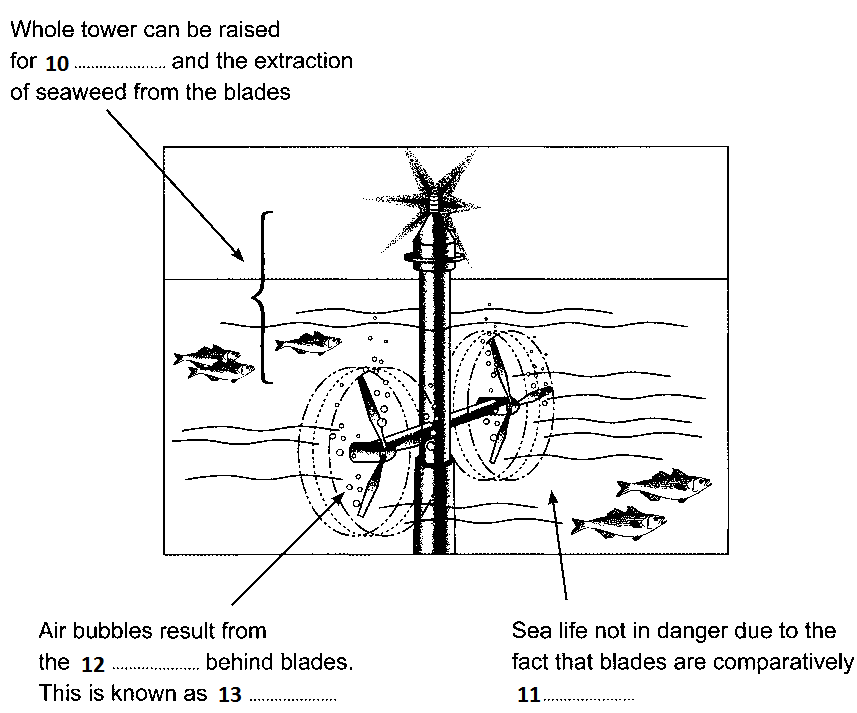
10. ___________
11. ___________
12. ___________
13.___________
Premium IELTS Coaching
at an Affordable Price
Answers for Tidal Power Reading Passage with Explanations
In the following details, you can explore the answers of tidal power reading passage with an explanation. Students often face challenges to get the correct response during the real exam, so read these solutions and understand how you have to attempt the reading section.
Question 1
Question 2
Question 3

Unlock All Explanations for Free
Question 4
Question 5
Question 6
Question 7
Question 8
Question 9
Question 10
Question 11
Question 12
Question 13

IELTS Prep Boost
Unlimited Access Includes
Other Passages
teste
teste
Quick Links
With the above information, you have explored the answers of tidal power passage. Here, the writer discusses the undersea turbines that produce electricity from the tides, which is an important source of electricity in Britain. The process of producing electricity in water is from tidal currents, which turn blades into ships’ propellers. This technology increases is beneficial for Britain to become self-efficient and produce renewable energy.
Hopefully, you are clear with the intent of the reading passage from the above paragraph. If you think this passage is beneficial for your reading skills, you must practice with IELTS sample test PDFs where you can improve other sections of the exam.
Tips for Acing Tidal Power Reading Passage
In the tidal power reading answers, a total of 13 questions are covered, including three different task types. To solve each one, you must know the right strategy to use. Here, we have mentioned some tips to help you find the correct answers in the passage.
- When you solve matching information questions in the passage, try to focus on the given details in the question. After this, scan it from the text.
- While solving multiple choice questions with multiple answers, focus on the questions’ information and pick keywords. After this, try to search for the keywords in the passage and identify the related information.
- In diagram labelling questions, understand the picture and focus on the given details. After this, based on the image information, try to find relevant things in the text.
Question Types in This Reading Passage
There are different types of questions covered in tidal power reading answers. To understand the format of each, you have to carefully read the instructions. We have explained each task type pattern in the following information, so keep reading for better insights.
Matching Information Questions (1-4)
In this passage, 1-4 questions are based on matching information. You have given specific details which are taken from the text. It can be a specific sentence or a phrase. You have to match them with the correct letter from A to F and identify which paragraph contains that information.
Multiple Choice Questions with Multiple Answers (5-9)
There are 5-9 questions based on the multiple choice questions with multiple answers. In this, you have given a question along with options from A to J. You have to read all the options and look for the five correct claims that have been made by the writer. You can write the answers in letters in any order.
Diagram Labelling Questions (10-13)
You have given 10-13 questions based on diagram labelling. In this question type, you have to observe an image that shows some features, and you are given some information along with a few blanks, which is related to the passage. Now, you have to fill in those blanks after finding the correct answer.
Conclusion
To conclude, we have discussed the tidal power reading answers with an explanation in this write-up. Hopefully, now you are clear with the IELTS reading format and understand how to solve questions during the real test. Apart from this, if you want to observe your other skills in the exam, you can join online IELTS coaching. This is the way to develop your overall skills under a professional’s guidance. They will provide you IELTS reading mock test, sample questions, and other important resources so you can get a good band score.
