
The History of Cakes at Wedding Reading Answers with Explanations
Still not prepared for the IELTS reading? If yes, then you have landed on the right page. This page contains the history of cakes at wedding reading answers, along with explanations. It's time to rack your brain and start practicing. Similar to the real test, this test contains a proper reading passage and questions along with instructions. You need to read the given tasks and text as well.
After this, you will attempt all questions and can match your responses with the list below. Read on!
IELTS Prep Boost
Elevate your preparation with exclusive tools
Unlimited Access Includes
BEST PLANDuration Days
IELTS Reading Passage: The History of Cakes at Wedding
Paragraph- A
In Western cultures, since antiquity. Weddings have customarily been celebrated with a special cake. Ancient Roman wedding ceremonies were finalized by breaking a cake of wheat or barley over the bride’s head as n symbol of good fortune. The newly married couple then ate some of the crumbs together. Afterward, the wedding guests gathered up the remaining crumbs as tokens of good luck. Wedding guests were also supplied with sweetmeats called confetti, a sweet mixture of nuts, dried fruit, and honeyed almonds. Handfuls of confetti were showered over the bride and groom; indeed, it seems to have been the custom to throw confetti about enthusiastically. Eventually, confetti in the form of sweets and nuts was replaced with rice, flower petals, or colored paper, and these new types of confetti continue to be thrown over newly married couples in many countries around the world.
Paragraph- B
When the Romans invaded Britain in 43 AD, many of their customs and traditions became part of British life. These customs included their wedding customs, and when the Normans invaded Britain in 1066, they brought many French traditions. Other changes came about due to increased trade and contact with Europe, but present-day British wedding traditions remain firmly rooted in the past. In medieval Britain, small spiced buns, which were common everyday fare, were often eaten at weddings. These were stacked in a towering pile, as high as possible. If the bride and groom were able to kiss over the tall stack, it augured a lifetime of riches. The earliest British recipe exclusively for eating at weddings is Bride Pie, which was recorded in 1685. This was a large round pie with an elaborately decorated pastry crust that concealed a filling of oysters, pine nuts, lamb and spices. Each guest had to eat a small piece of the pier; not to do so was considered extremely impolite. A ring was traditionally placed in the pie, and the lady who found it would be next to marry.
Paragraph- C
In the 17th century, Bride Pie was changed into Bride Cake, the predecessor of the modern British wedding cake. Cakes containing dried fruit and sugar, symbols of prosperity, gradually became the centerpieces for weddings. Some people made Bride Cake in the cheaper form of two large rounds of pastry sandwiched together with currants and sprinkled with sugar. Very few homes at the time could boast of having ovens, but this type of pastry cake could be cooked on a baking stone on the hearth.
Paragraph- D
Later in the 17th century, there was a new development when wedding cakes began to be made in pairs, one for the bride and another for the groom. Both cakes were dark, heavy fruitcakes; the groom’s cake was smaller than the bride’s cake, and was cut up into little squares that were placed in boxes for the guests to take home as a wedding memento. Groom’s cakes gradually died out and are no longer part of British weddings. However, the tradition has undergone a revival in the United States, where for many years the groom’s cake has served as a wedding gift for guests. Modern groom’s cakes are often formed and decorated to depict the groom’s hobby, for example, a golf bag, a camera, or a chessboard.
Paragraph- E
Groom’s cakes were never covered with icing, but the Bride Cake, covered with white icing, first appeared sometime in the 17th century. After the cake was baked, it was covered with a pure white, smooth icing made with double-refined sugar, egg whites, and orange-flower water. The mixture was beaten for two hours, then spread over the cake and dried in the oven until hard. A pure white color was much sought after for wedding cake icing because white icing meant that only the finest refined sugar had been used. Thus, a pure white cake was a status symbol, as it displayed the family’s wealth.
Paragraph- F
The late 1800s in Britain saw the introduction of a new tradition, with the first multi-tiered wedding cakes. These were impressive cakes: they were heavy because they were made with so much dried fruit, and highly decorated with icing and embellished with sugar flowers, doves, horseshoes, and bells. The first multi-tiered cakes comprised iced cakes stacked on top of each other rather like a succession of boxes gradually decreasing in size. The cakes from the upper tiers did not sink into the lower tiers because they were a bit put on top of each other until the icing between each cake had had time to harden. It was not until the beginning of the 20th century that the cake tiers were separated and supported by columns.
Paragraph- G
Twenty-first-century weddings are big business for Britain’s wedding industry. Over 300,000 people get married each year, and a wedding can cost thousands of pounds. The cost of the all-important wedding cake can be hundreds of pounds, depending on the dimensions and design. It will be interesting to see whether wedding cakes continue to be popular at weddings.
Questions for This Passage: The History of Cakes at Wedding
QUESTIONS 1 - 6
Do the following statements agree with the information given in Reading Passage 1?
In boxes 1-6 on your answer sheet, write
TRUE- if the statement agrees with the information
FALSE- if the statement contradicts the information
NOT GIVEN- if there is no information on this
1. Breaking a cake over the bride’s head was the last part of an ancient Roman wedding ceremony.
2. Confetti is still made of nuts, dried fruit, and honeyed almonds.
3. The groom’s family used to supply the confetti.
4. It was considered lucky for a newly married couple to be able to kiss over a tower of spiced buns.
5. Only brides were allowed to eat Bride Pie.
6. The wedding cakes eaten in Britain today developed from the Bride Cake of the 17th century.
QUESTIONS 7 - 9
Complete the notes below.
Choose ONE WORD ONLY from the passage for each answer.
Write your answer in boxes 7-9 on your answer sheet.
Wedding cakes
17th century- Britain Bride Cake:
- expensive ingredients were a sign of wealth
- less expensive round cakes were made of 7 _______ with currants in between and sugar on top
- they were baked on a hearth stone because not all homes had 8 _____
Now- United States - Groom’s cake:
- guest receive pieces of the groom’s cake
- cakes may represent the 9 _______ of the groom
QUESTIONS 10 - 13
Label the diagram below.
Choose ONE WORD ONLY from the passage for each answer.
Write your answers in boxes 10-13 on your answer sheet.
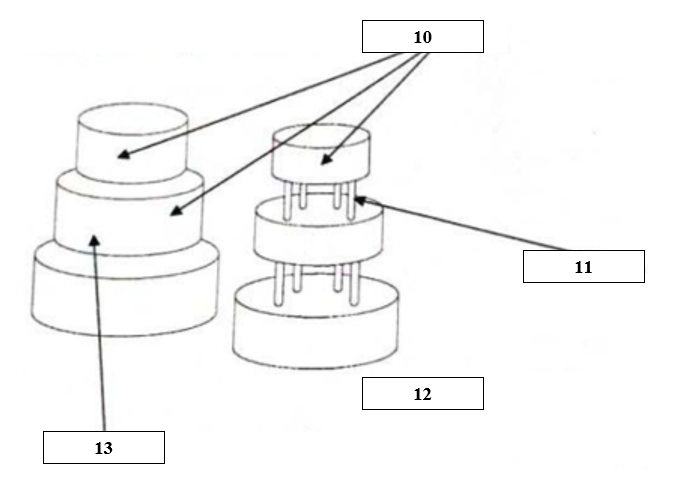
10. Examples of wedding cakes with several ______ .
11. In the early 1900s, ______ were used to keep individual cakes apart.
12. The size of these cakes as well as their _______ affects pricing.
13. Hardened _______ between cakes stopped higher cakes sinking into tower cakes.
Premium IELTS Coaching
at an Affordable Price
Answers for the History of Cakes at Wedding Reading Passage with Explanations
In the following information, we have provided you with the answers of the history of cakes at wedding reading passage along with explanations. You can use the answers to match your responses.
Question 1
Question 2
Question 3

Unlock All Explanations for Free
Question 4
Question 5
Question 6
Question 7
Question 8
Question 9
Question 10
Question 11
Question 12
Question 13

IELTS Prep Boost
Unlimited Access Includes
Other Passages
teste
teste
Quick Links
With the above information, you have explored the history of cakes at wedding reading answers with their explanations. In this text, the writer discusses the Western cultures where weddings have been celebrated with a special cake. Ancient Roman weddings used to be finalized by breaking a cake over the bride’s head as a symbol of good fortune. It was a tradition to do this. After this, the newly married couple then ate some of the crumbs together. Afterward, the wedding guests gathered up the remaining crumbs as tokens of good luck. In the whole passage, you will read the evolution of wedding cakes from ancient Roman traditions to modern multi-tiered cakes.
Hopefully, you are clear with the intent of the text from the above paragraph. If you liked this sample and want to experience the real exam environment, it is advisable to take the IELTS reading mock test and practice accordingly.
Tips for Acing the History of Cakes at Wedding Reading Passage
In the following information, we will provide you with some tips to find the answers of the history of cakes at wedding ielts reading passage. There are three types of questions, and to solve each, you must have the right strategy. So, let’s read about them below.
- While solving true, false, and not given questions, pick some unique words from the given sentences. You can find synonyms and related information from the passage and get the correct answer.
- In the notes completion task, your answer will be based on one word only. So, try to find the response after reading the information and scan for the missing information. If you carefully read the statement, you can get the accurate response.
- When you solve diagram labeling questions, understand the sequence of the picture. Check the instructions and symbol given there. After this, read the sentences provided to find the accurate response.
Types of Questions in the History of Cakes at Wedding Reading Passage
As you know, there are a variety of questions covered in the history of cakes at wedding reading answers. Before starting to attempt, you must read the instructions, and you should know the right steps to solve them. Here’s a detailed overview.
True, False, Not Given Questions (1-6)
You will have some sentences given, which are taken from the passage. You have to read them, understand the intent, and write:
- True, if the statement agrees with the information.
- False, if the sentence contradicts the information.
- Not given, if there are no details about the sentence.
Notes Completion Questions (7-9)
There is some information taken from the passage and written in pointers. You have to read them and fill in the missing information where you see the blanks. The answer length must be within one word only. After scanning the text, you will be able to find an accurate response.
Diagram Labeling Questions (10-13)
In the diagram labeling questions, you have a picture along with some symbols, arrows, etc, and a list of sentences. You have to read them, fill in the empty spaces where you need to write the answer. For this question, the answer length is one word only.
Conclusion
To conclude, we have discussed the history of cakes at wedding reading answers along with explanations. Hopefully, you practiced it well and solved all the questions in a sequence. To improve your band scores, this sample can be a perfect guide. Apart from this, you can take IELTS sample test PDFs and find more common topics to practice anytime, anywhere. In case you have an issue in any other section, you can take offline or online IELTS coaching and practice under a professional’s guidance.
