
New Zealand Seaweed Reading Answers with Explanations
Achieving 7.5 or 8.5 bands in the IELTS reading section can be a big challenge for test takers. The reason behind this is the unfamiliarity with a different set of task types and topics. If you continue to practice for the test and explore a variety of sample questions, you may succeed in this section.
This guide contains New Zealand seaweed reading answers along with explanations. You need to read the questions first, then go through the text. In this way, you will understand the intent of the passage and can easily find answers to the questions. Read on!
IELTS Prep Boost
Elevate your preparation with exclusive tools
Unlimited Access Includes
BEST PLANDuration Days
IELTS Reading Passage: New Zealand Seaweed
Section A - Nutritious value of seaweeds
Seaweed is a particularly nutritious food, which absorbs and concentrates traces of a wide variety of minerals necessary to the body's health. Many elements may occur in seaweed - aluminium, barium, calcium, chlorine, copper, iodine and iron, to name but a few - traces normally produced by erosion and carried to the seaweed beds by river and sea currents. Seaweeds are also rich in vitamins: indeed, Eskimos obtain a high proportion of their bodily requirements of vitamin C from the seaweeds they eat.
The nutritive value of seaweed has long been recognised. For instance, there is a remarkably low incidence of goitre amongst the Japanese, and for that matter, amongst our own Maori people, who have always eaten seaweeds, and this may well be attributed to the high iodine content of this food. Research into old Maori eating customs shows that jellies were made using seaweeds, fresh fruit and nuts, fuchsia and tutu berries, cape gooseberries, and many other fruits which either grew here naturally or were sown from seeds brought by settlers and explorers.
Section B - Various products of seaweeds
New Zealand lays claim to approximately 700 species of seaweed, some of which have no representation outside this country. Of several species grown worldwide, New Zealand also has a particularly large share. For example, it is estimated that New Zealand has some 30 species of Gigartina, a close relative of carrageen or Irish moss. These are often referred to as the New Zealand carrageens. The gel-forming substance called agar, which can be extracted from this species, gives them great commercial application in seameal, from which seameal custard is made, and in cough mixture, confectionery, cosmetics, the canning, pain, and leather industries, the manufacture of duplicating pads, and in toothpaste. In fact, during World War II, New Zealand Gigartina were sent to Australia to be used in toothpaste.
Section C - Underuse of native species
Yet although New Zealand has so much of the commercially profitable red seaweeds, several of which are a source of agar (Pterocladia, Gelidium, Chondrus, Gigartina), before 1940, relatively little use was made of them. New Zealand used to import the Northern Hemisphere Irish moss (Chondrus crispus) from England and ready-made agar from Japan. Although the distribution of the Gigartina is confined to certain areas according to species, it is only on the east coast of the North Island that its occurrence is rare. And even then, the East Coast and the area around Hokiangna have a considerable supply of the two species of Pterocladia from which agar is also available. Happily, New Zealand-made agar is now obtainable in health food shops.
Section D - Locations and features of different seaweeds
Seaweeds are divided into three classes determined by colour - red, brown, and green - and each tends to live in a specific location. However, except for the unmistakable sea lettuce (Ulva), few are totally one colour; and especially when dry, some species can change colour quite significantly - a brown one may turn quite black, or a red one appear black, brown, pink or purple.
Identification is nevertheless facilitated by the fact that the factors which determine where a seaweed will grow are quite precise, and they therefore tend to occur in very well-defined zones. Although there are exceptions, the green seaweeds are mainly shallow-water algae; the browns belong to medium depths, and the reds are plants of the deeper water. Flat rock surfaces near mid-level tides are the most usual habitat of sea bombs, Venus’ necklace, and most brown seaweeds. This is also the location of the purple laver or Maori karengo, which looks rather like a reddish-purple lettuce. Deep-water rocks on open coasts, exposed only at very low tide, are usually the site of bull kelp, strap weed, and similar tough specimens. Those species able to resist long periods of exposure to the sun and air are usually found on the upper shore, while those less able to stand such exposure occur nearer to or below the low-water mark. Radiation from the sun, the temperature level, and the length of time immersed all play a part in the zoning of seaweeds.
Section E - How seaweeds reproduce and grow
Propagation of seaweeds occurs by spores or by fertilisation of egg cells. None have roots in the usual sense; few have leaves, and none have flowers, fruits, or seeds. The plants absorb their nourishment through their fronds when they are surrounded by water: the base or "holdfast" of seaweeds is purely an attaching organ, not an absorbing one.
Questions for This Passage: New Zealand Seaweed
Questions 1-6
Reading Passage 1 has six sections A-F.Choose the correct heading for each section from the list of headings below.
Write the correct number i-x in boxes 1-6 on your answer sheet.
List of Headings
I. Locations and features of different seaweeds
II. Various products of seaweeds
III. Use of seaweeds in Japan
IV. Seaweed species around the globe
V. Nutritious value of seaweeds
VI. Why doesn't it dry or sink
VII. Where to find red seaweeds
VIII. Underuse of native species
IX. Mystery solved
X. How seaweeds reproduce and grow
1. Section A
2. Section B
3. Section C
4. Section D
5. Section E
6. Section F
Questions 7-10
Complete the flow chart below.
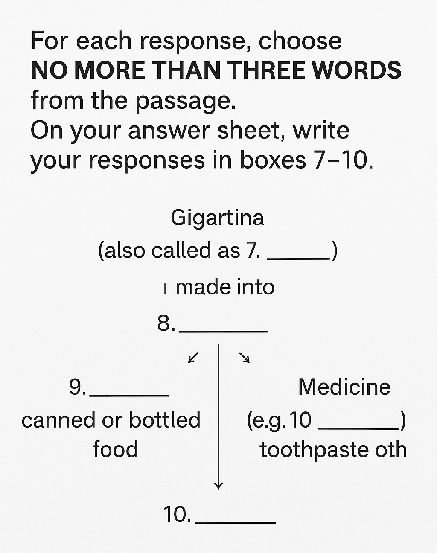
7. _________
8. _________
9. _________
10. _________
Questions 11-13
Classify the following description as relating to
A. Green seaweeds
B. Brown seaweeds
C. Red seaweeds
Write the correct letter A, B, or C in boxes 11-13 on your answer sheet.
11. Can resist exposure to sunlight at the high-water mark
12. Grow in far open sea water
13. Share their habitat with karengo
Premium IELTS Coaching
at an Affordable Price
Answers for New Zealand Seaweed Reading Passage with Explanations
In the following information, we are going to provide you with the answers of New Zealand seaweed reading passage. At first, try to identify the intent of the question and text, understand the meaning, and find the response. If you failed to look for the correct answer, you can go through the list below and read the explanation too.
Question 1
Question 2
Question 3

Unlock All Explanations for Free
Question 4
Question 5
Question 6
Question 7
Question 8
Question 9
Question 10
Question 11
Question 12
Question 13

IELTS Prep Boost
Unlimited Access Includes
Other Passages
teste
teste
Quick Links
With the above details, you have explored the answers to the New Zealand seaweed passage along with explanations. This passage discusses the high nutritional value of seaweed, which absorbs various minerals and has been linked to iodine deficiency prevention in populations like the Maori people. The passage highlights NZ’s rich biodiversity, with 700 unique and abundant seaweed species, particularly red seaweeds used to produce agar. Though NZ historically underutilized its red seaweed resources and even imported agar before 1940.
This was the quick overview of the passage you solved above. Hopefully, you found it beneficial for your IELTS exam preparation. If you are looking for more study resources like this, you may refer to the IELTS reading mock test and experience the real test environment.
Tips for Acing New Zealand Seaweed Reading Answers
The New Zealand seaweed reading answers contain a variety of task types. To solve each of them, you should know the right strategy. In the following details, we have provided you with some tips that will help you identify the correct response.
1. When you solve the matching heading type of task, go through the text carefully. Read the list of headings and try to find the relevant information from each section of the passage. Look for synonyms and similar details for a better answer.
2. In the flow chart type of questions, understand the sequence from the image and identify what is presented to you. As per the sequence, find the details given in the text, and you will get the answer.
3. In the classifying information task, first read the question, and then it gives options. This way, you will be able to locate the correct answer. You can also focus on the list from A to C, and read the sentences where you find information.
Types of Questions in New Zealand Seaweed Reading Passage
There are various types of questions you get when you solve the IELTS reading section. The New Zealand seaweed reading answers contain three types of questions. Before taking the test, you should know how to approach it and what instructions to follow. Let’s read about it in detail.
Matching Heading Questions (1-6)
In the passage, you have given 1-6 questions based on the matching heading type. In this task, you have been given a few lists of options which you need to read. After this, you have to identify, from section A to section F, which is the correct heading for each. For that, read the question first and then look for relevant information.
Flow Chart Completion Questions (7-10)
You have provided 7-10 questions based on flow chart completion. In this question type, you have to understand the sequence of the flow chart and identify what is explained in the picture. Then, you will fill in the blanks, which are shown in the image. You have to observe the process and find relevant information, and enter the correct response.
Classify Information Questions (11-13)
From questions 11 to 13, you have to solve a classification information task. In this, you have given a few lists of options from A to C along with questions containing details. You need to read the sentence and classify the description relating to which one of A to C.
Conclusion
To conclude, you have solved the New Zealand seaweed reading answers along with explanations. In this test, you have attempted three question types. Hopefully, now you have understood how you need to act when you practice for the reading section. However, you can also prefer the IELTS sample test PDFs and rehearse with a variety of topics. In case you face any issues in other sections of the exam, you can join offline or online IELTS coaching and access more facilities.
