
Factsheet Aluminum Cans IELTS Listening Practice Test with Answers
The Factsheet Aluminum Cans listening answers serves as a valuable resource aimed at enhancing your performance in the IELTS exam. It is designed to help you become familiar with common question types, such as note completion and diagram labeling questions, which require careful listening for specific details as well as concise summarisation of information.
Engaging with this material will assist you in sharpening your ability to identify key information, interpret academic vocabulary, and extract specific details skills that are essential for successfully navigating the challenging IELTS listening section and boosting your overall scores.
IELTS Prep Boost
Elevate your preparation with exclusive tools
Unlimited Access Includes
BEST PLANDuration Days
Transcripts for Factsheet Aluminum Cans
Ilma: Hi, Dawn.
Dawn: Oh, hi, Ilma.
Ilma: I'm glad I've bumped into you. I've just found a great idea for the presentation we've got to do for Dr. Banks next month.
Dawn: What, the one on everyday object?
Ilma: Yes. Look at this article. It's really interesting.
Dawn: The aluminium coat can?
Ilma: You know. Coca-Cola cans, soft drink cans. Look, let's sit down here. Have you got a minute?
Dawn: Sure. I'll just get my bag. Okay. So, you think we can get a presentation out of this article?
Ilma: I'm sure we can. First of all, we can provide some interesting facts about the aluminium cans that we drink out of every day.
Dawn: Light?
Ilma: Well, here it says that in the US they produce 300 million aluminium drink cans each day.
Dawn: Wow, 300 million.
Ilma: Exactly. That's an enormous number. It says here, outstrips the production of nails or paperclips. And they say that the manufacturers of these cans exercise as much attention and precision in producing them as aircraft manufacturers do when they make the wing of an aircraft.
Dawn: Really? Let's have a look.
Ilma: They're trying to produce the perfect can as thin but as strong as possible.
Dawn: This bit's interesting. Today's can weighs about 0.48 ounces, thinner than two pieces of paper from Miss Magazine say.
Ilma: Yeah. And yet it can take a lot of weight.
Dawn: More than 90 pounds of pressure per square inch. Sweet times the pressure of a car tire. Okay. I agree. It's a good topic.
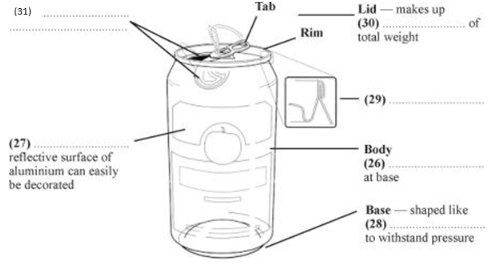
Ilma: What I thought was that we could do a large picture of a coat can and label it and then talk about the different parts. Look, I've done a rough picture here.
Dawn: Okay. So where shall we start?
Ilma: Well, the lid is complicated. Let's start with the body first. I'll do a line from the centre of the can like this and label it body. What does it say?
Dawn: It's made of aluminium, of course. And it's thicker at the bottom.
Ilma: Right. So that it can take all that pressure.
Dawn: And now I think you should draw another line from the body for the label.
Ilma: Right. Label. The aluminium is ironed out until it's so thin that it produces, what does it say?
Dawn: A reflective surface suitable for decoration.
Ilma: That's right. Apparently it helps advertise us too.
Dawn: Yes, because it's so attractively decorated.
Ilma: Good. And then there's the base.
Dawn: Yes, it says the bottom of the can is shaped like a dome so that it can resist the internal pressure.
Ilma: That's interesting. I didn't know that.
Dawn: What did I? Okay, so going up to the lid. There are several things we can label here. There's the rim around the edge which seals the can.
Ilma: Got that.
Ilma: And there's a funny word for the seal, isn't there?
Dawn: Yes. It's a flange.
Ilma: What does it say about it?
Dawn: Well, the can's filled with coke or whatever. And after that, the top of the can is trimmed and then bent over to secure the lid.
Ilma: That's right. It looks like a seam. We could even do a blow-up of it like this. F L A M G E.
Dawn: Yes, that would be clearer. I think we should label the lid itself and say that it constitutes 25% of the total weight.
Ilma: 25%. So it's stronger than the body of the can.
Dawn: So to save money, manufacturers make it smaller than the rest of the can.
Ilma: Didn't know that either. So I had to reopen a can of coke.
Dawn: First of all, there's the tab which we pull up to open the can and that's held in place by a rivet.
Ilma: I think that's too small for us to include.
Dawn: I agree. But we can talk about it in the presentation. We can show the opening though.
Ilma: That's the bit of the can that drops down into the drink when we pull the tab.
Dawn: Yeah, hopefully. Sometimes the tab just breaks off.
Ilma: I know.
Dawn: Anyway, the opening is scored so that it pushes in easily but doesn't detach itself.
Ilma: Okay. We can show that by drawing a shadow of it inside the can. Like this. I'll label it scored opening. Great. I think we've got the basis of a really interesting presentation. Let's go and photocopy the article.
Dawn: Fine. I'll take it home and study it for more.
Questions for Factsheet Aluminum Cans Listening Test
Questions 1-4
Complete the factsheet. Write NO MORE THAN THREE WORDS for each answer.
FACTSHEET- Aluminium Cans
__1__ produced every day in the US- more cans produced than nails or __2__
each can Weighs 0.48 ounces- thinner than two __3__
can take more than 90 pounds of pressure per square inch- over __4__ the pressure of a car tyre.
Questions 5-10
Label the alumni can. Write NO MORE THAN THREE WORDS for each answer.
Premium IELTS Coaching
at an Affordable Price
Answers of Factsheet Aluminum Cans Listening Test
Below, you will find the answers of Factsheet aluminum cans listening test. We encourage you to review them carefully.
Question 1
Question 2
Question 3

Unlock All Answers for Free
Question 4
Question 5
Question 6
Question 7
Question 8
Question 9
Question 10

IELTS Prep Boost
Unlimited Access Includes
Other Passages
teste
teste
Quick Links
You have explored the Factsheet aluminum cans IELTS listening answers based on the details provided. Furthermore, you have listened to the corresponding audio, which features a conversation between two students Dome and Imma are discussing a project together. In their discussion, one student explains the aluminium can recycling process to an audience, covering the steps from household collection to melting, rolling, and reuse. This summary highlights the main points discussed in the audio.
We trust that you have grasped the key concepts from the information provided. With this understanding, you should find it easier to tackle this task. However, if you experience any challenges, we recommend considering enrollment in IELTS online coaching at Gradding. Our expert team is here to support you in refining your skills for the IELTS exam.
Key Highlights of the IELTS Listening Section
- The listening section follows a structured format for both Academic and General Training versions.
- Audio recordings are played only once.
- Each recording typically contains 10 questions, though some may include just 5.
- The section comprises four parts, each featuring a single audio recording.
- This consistent format ensures a fair evaluation for all test takers.
Task Types in Factsheet Aluminium Cans IELTS Listening Answers
The Factsheet aluminum cans listening answers encompass note completion and diagram labeling question type. Below, you will gain a deeper understanding of this question type.
Note Completion
In the IELTS listening section, note completion questions require you to fill in the gaps in a set of incomplete notes using words or short phrases taken directly from a reading passage. These notes often summarise a section of the text and test your ability to identify the main ideas and locate relevant information.
Diagram Labeling
In the IELTS listening section, diagram labeling questions require you to identify and fill in missing labels on a diagram, map or technical drawing using words from a provided passage.
Be sure to read the guidelines thoroughly to understand what is expected. If you seek further practice in the listening section, we encourage you to explore the IELTS Self Help Kit, which offers excellent resources for effective self-preparation.
Familiarising yourself with common pitfalls can assist you in avoiding unnecessary point deductions:
- Ignoring Question Guidelines: Different questions may have specific requirements, such as word limits. It’s important to pay close attention to these instructions.
- Leaving Blank Spaces: Unlike the reading section, do not leave answers blank. Since there’s no negative marking, attempting to answer is advantageous.
- Spelling and Grammar Errors: Take a moment to double-check your answers for spelling and grammatical accuracy when transferring them to the answer sheet.
IELTS Band Calculation for the Listening Section
The IELTS listening section consists of 40 questions, with each correct answer awarding one point. Your score out of 40 will then be converted to the IELTS band scale, reported in whole and half bands.
| Band Score | Score / 40 |
|---|---|
| 9 | 39-40 |
| 8.5 | 37-38 |
| 8 | 35-36 |
| 7.5 | 33-34 |
| 7 | 30-32 |
| 6.5 | 27-29 |
| 6 | 23-26 |
| 5.5 | 19-22 |
| 5 | 15-18 |
| 4.5 | 13-14 |
| 4 | 10-12 |
| 3.5 | 8-9 |
| 3 | 6-7 |
| 2.5 | 4-5 |
Conclusion
Overall, the Factsheet aluminum cans listening answers offer valuable insights into diagram labeling and form completion tasks. For an engaging practice experience, we recommend participating in our IELTS listening mock test and utilising additional study materials.
